the porcupine presents ...
the intersection of history, culture, and storytelling—past and present
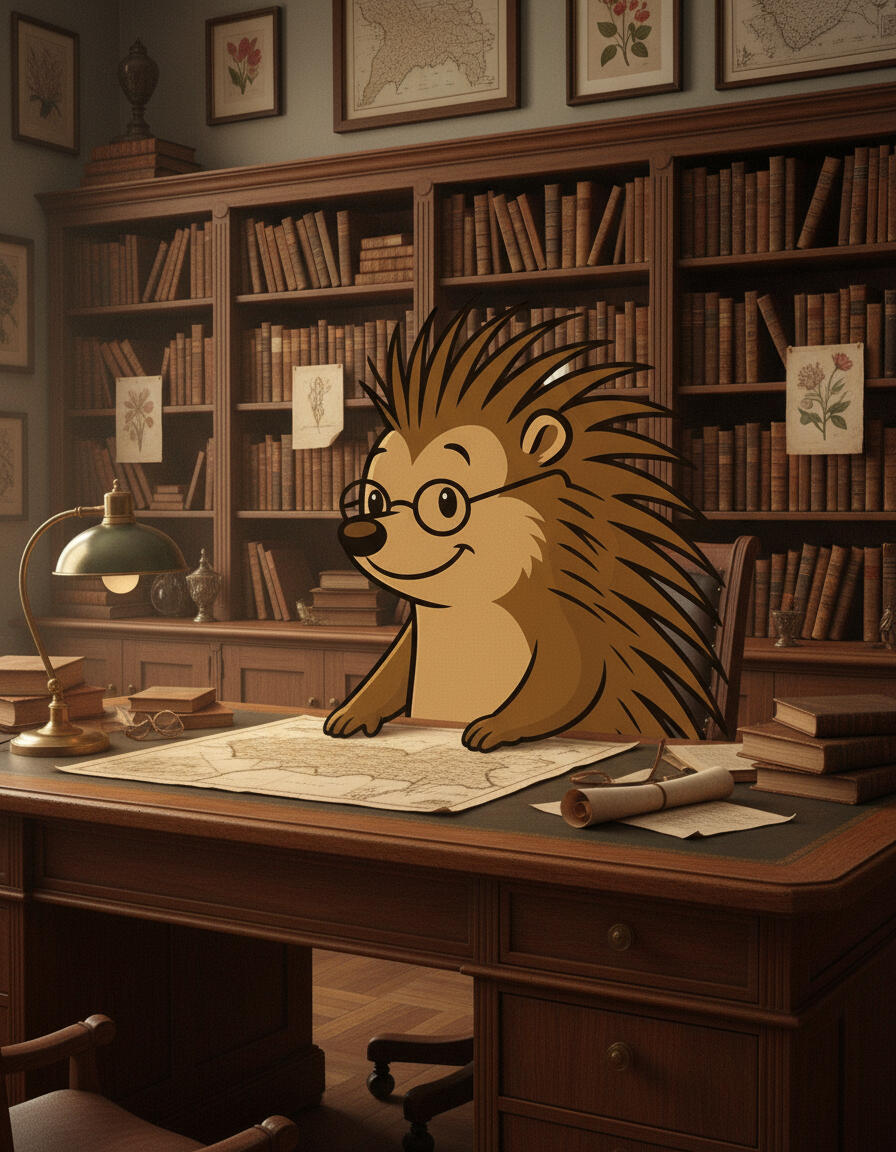

about the porcupine
“The Porcupine Presents ...” is the creative home of Corie Schweitzer—a writer, editor, former academic, and lifelong listener and creator of stories.After a brain injury reshaped how I read and write, audio, collaboration, and curiosity became not just creative choices, but necessities.This site is where those necessities turned into projects.

“The Porcupine Presents ...” isn’t a single show or a static format. It’s a small studio for ideas—a place where history, storytelling, humor, and analysis overlap. Some projects are scripted. Some are curated. Some are experimental. All of them are made with care for language, context, and the people listening.
Current Projects
🦔 The Porcupine Presents ...
Curated vintage radio, original commentary, and historical context—exploring how old stories still shape modern fears, desires, and ideas.
🎭 “The World’s Worst Docent”
Satirical audio tours led by hilariously unqualified guides, exposing how institutions talk when they stop making sense.
🐾 “Detective Steve”
A noir comedy mystery series starring a grumpy, aging dog detective — funny, melancholy, and unexpectedly sincere.
🧠 Essays & Experiments
Occasional writing and audio projects about genre, technology, memory, and the strange ways humans make meaning.
🕵️ Original Fiction & Screenplays
Narrative fiction and scripted audio, including “Sherlock Holmes: The Last Analysis”—reworking classic genres to explore memory, psychology, and moral consequence.
🗺️ Ramble Through Victorian London
An interactive map project tracing nineteenth-century London through its institutions, streets, and fault lines—where power, poverty, culture, and violence intersected.
audio / visual archive

The Porcupine ...
invites you to search our archives and explore the intersection of storytelling and analysis
quills: original writings
Screenplays
“THE BIG BEND”
(romantic comedy/drama)Logline: A stoic park ranger falls for her spirited new hire and discovers her heart—and the guts to save local ranchers from being screwed by the land speculator funding her Dad’s run for governor.
“LIVES OF THE SAINTS”
(drama/comedy)Logline: A recovering alcoholic taking care of his deceased sister’s daughter struggles to maintain a secret when he starts a relationship with a woman who was the victim of a hit-and-run the same night he lost his sister.
“THE CHRISTMAS COOKIE WAR”
(romantic comedy)Logline: Two bitter rivals locked in an annual Christmas cookie competition spend the season trading insults, sabotaging each other’s recipes, and fighting for the crown—until falling in love threatens to ruin everything they’ve worked so hard to hate.
Scholarly Essays
“Publishing ‘New’ Canons: The Aesthetics of Recovering Texts.” The Essential JSP: University Presses 1 (2011).
“Public Good and Private Mischief: Daniel Defoe’s Journal of Three Nations in A Journal of the Plague Year.” Eighteenth-Century Novel 1 (2000).
“Publishing ‘New’ Canons: The Aesthetics of Recovering Texts.” Journal of Scholarly
Publishing 29, 4 (July 1998).
Substack
Viewing Requests
Request to read one of my screenplays: [email protected].
Please put make the subject line “Request for Screeplay.”
Thanks for stopping by! —The Porcupine
ramble through victorian london
What Is this Map?
This is a fully digitized edition of Stanford’s Library Map of London and Its Suburbs (c. 1862), originally engraved at an extraordinary scale of six inches to the mile. The physical map, when assembled, measures nearly five by five and a half feet.This version preserves that detail—and adds interpretation.This is not simply a beautiful Victorian map (though it is that). It is an interpretive guide to London at the midpoint of Queen Victoria’s reign—a city in the midst of becoming modern.Instead of organizing Victorian life by timeline or topic, this map organizes it by place. Each hotspot marks a site where power, knowledge, labor, justice, entertainment, poverty, protest, or violence shaped everyday experience.What matters is not only what existed—but what existed next to what.• Prisons stood beside courts.
• Libraries near the machinery of empire.
• Theaters within walking distance of workhouses.
• Scientific institutions embedded in commercial streets.
• Violence unfolded not in isolation, but inside ordinary neighborhoods.This map is about proximity—about how millions of people attempted to live coherent lives within a profoundly incoherent age.
How to Use the Map
There are four ways to explore Victorian London here.1. Wander.
Zoom in and walk the streets. Notice the farms that still dotted the outskirts in the 1860s. Observe the cattle markets and industrial yards. Be grateful that the muck, miasma, and stench of nineteenth-century London do not accompany you on your digital journey.2. Follow the Hotspots.
Click “Show Hotspots” to illuminate key institutions, industries, and figures. Select a site to explore a building, institution, or event. Zoom in and out to see how physically close—or far apart—these places truly were. The city reveals itself through movement.3. Explore by Neighborhood.
The original map divides London into eighty regions. Select “See Neighborhood Map” to move district by district and observe how communities formed distinct identities within the larger metropolis.3. Explore by Theme.
Fourteen thematic lenses allow you to isolate particular dimensions of Victorian life—from empire and education to gender, protest, and mortality. Many sites appear in more than one category. As then, so now: places hold multiple meanings. (Note: you need to “Show Hotspots” to explore the themes.)
If you would like to suggest a site not yet included, or have questions or comments about the project, please contact:
This map is not meant to be exhaustive. It is meant to be navigated. Having said all that ... let us delay no further ...